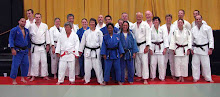
We’re going to do it!
Do you know who the Gracies are?
Did you know they have one of the best self-paced street defense training programs available for at-home study?
They do.
If you’re like me, though, self-paced and at-home mean I buy it and play with it for a while and never do anything with it. As a matter of fact, and you can check out my other blog post for a review and an idea of when I got them, I did do just that! So what I’ve decided to do is simple: We're going to use the DVD’s to learn the entire 36 techniques in the Gracie Combatives DVD series.
All 36 lessons. We’ll cover them three times each between January 4th and July. The best part about it? All you have to do is show up and be ready to work.
What’s the catch? Why is it free to you? Simple: I don’t have the money, the time, or the rank it takes to become a certifed instructor now. I also want to know if enough people really want to learn what they’re teaching before I plunk down the cash to take their course. We're just a judo club that's working on our ne waza and using this program to help us get better!
I hope you’ll come by and check it out. We can always use more partners and friends! They’re going to be on Tuesdays and Thursdays from 7:15-8:30pm and Fridays from 6:00-8:30pm.
31 December 2010


It’s the End of the Year as We Know It (And I Feel Fine)
What a wonderful year we had! 2010 saw our first students entering tournaments and bringing home medals! We gained a number of new students. We expanded our class offerings to two different adult classes and one youth class. Our students are staying longer and doing more in and out of class!
I think 2010 was one of the very best years ever for me and for Roswell Judo Club. I went to a number of clinics and even held a few! Learning from Hayward Nishioka, Gerald Lafon, and Lynn Roethke (among others) in Las Vegas was a rare and wonderful opportunity. Being uke for Paul Nogaki in Albuquerque was an awesome experience and one I’d like to have the opportunity to do again (maybe 2011?)! Teaching my first clinic to Rolando and Eddy on Tai Otoshi was quite a humbling experience. Having Tony, Cody, and Daniel come in from Daniel to work with my guys was another great experience, especially with Tony validating my opinion on Rolando!
Next year promises to be a banner year as well with quite a few inquiries for the youth and adult classes. I’m also planning on offering the Gracie Combatives DVD course as a no cost opportunity (more details in the next post) for adults only.
I really and truly want to thank everybody who helped Roswell Judo Club. The Yucca Recreation Center, Ms. Lynn, Ms. Linda, Sergeant Bell, Mary, every single student whether you’re still with us or not, Toby and the entire NMSU Judo Club, Oscar and his crew from Mesilla Valley Judokai, Tony, Cody, and Daniel from Dallas, and everybody else whose name escapes me right now. Thank you so much for supporting us!
I think 2010 was one of the very best years ever for me and for Roswell Judo Club. I went to a number of clinics and even held a few! Learning from Hayward Nishioka, Gerald Lafon, and Lynn Roethke (among others) in Las Vegas was a rare and wonderful opportunity. Being uke for Paul Nogaki in Albuquerque was an awesome experience and one I’d like to have the opportunity to do again (maybe 2011?)! Teaching my first clinic to Rolando and Eddy on Tai Otoshi was quite a humbling experience. Having Tony, Cody, and Daniel come in from Daniel to work with my guys was another great experience, especially with Tony validating my opinion on Rolando!
Next year promises to be a banner year as well with quite a few inquiries for the youth and adult classes. I’m also planning on offering the Gracie Combatives DVD course as a no cost opportunity (more details in the next post) for adults only.
I really and truly want to thank everybody who helped Roswell Judo Club. The Yucca Recreation Center, Ms. Lynn, Ms. Linda, Sergeant Bell, Mary, every single student whether you’re still with us or not, Toby and the entire NMSU Judo Club, Oscar and his crew from Mesilla Valley Judokai, Tony, Cody, and Daniel from Dallas, and everybody else whose name escapes me right now. Thank you so much for supporting us!
17 December 2010
The Latest News That Is News!
Roswell Judo Club held its last promotional for the year on the 16th. This promotional raised three of our juniors to their next grades. Now our junior class has a Junior 3 and two Junior 1’s.

There won’t be any classes for the next two weeks. We’ll be starting up again on the 3rd of January for the Adults and the 4th for the Youths. Keep close tabs on the club website and the blog for the schedule and the events! When we start back up, we’ll have a lot of work and fun, so be prepared!

There won’t be any classes for the next two weeks. We’ll be starting up again on the 3rd of January for the Adults and the 4th for the Youths. Keep close tabs on the club website and the blog for the schedule and the events! When we start back up, we’ll have a lot of work and fun, so be prepared!
16 December 2010
Now Taking Requests
You've been reading my blog, maybe for a long time maybe not. I'd like you to keep coming back. So I'd like to ask you to tell me some of the things you'd like me to write about. Post a comment about what you'd like to know, and I'll see what I can do to find out about it and write something up!
03 December 2010
Teaching with a Plan
A lot of things have happened for the Roswell Judo Club since August, but first I want everyone who reads this blog to know that the most important thing an instructor can do is teach the fundamentals of whatever it is they are teaching. In my case it is teaching people how to be better people through judo. Over the last several months I’ve learned a lot, especially about making sure there’s a plan in place for every single class.
Tonight I had a plan. It started with warm-ups, moved to ukemi, then on to technical instruction. I expected about six students, but when I walked in only two were there. So much for the plan. I started with the contingency plan of having the two run the mat, forward, shuffling facing in, backward, and shuffling facing out. Then I got creative and ran them through somersaults, backward somersaults, shoulder rolls, somersaults with back, right, and left falls, and even front falls diagonally across the mat. When they did one diagonal event they bear-crawled, frog-hopped, crab-walked, and so on back to their starting place. The best part of the warm-up was that they had fun doing it.
Then we moved on. It’s getting time for promotionals so I wanted to make sure they know their stuff so we started with a diagonal ashi-waza drill I learned from Paul Nogaki. We moved from that into learning how to turn. While turning is a seemingly dynamic exercise, it’s only turning about an axis rather than turning about an axis while moving linearly. Since no judo happens standing in place, we practiced walking down the mat and turning around. As the students were doing this, I had an epiphany! If they could do this walking down the mat, why not have them do O goshi with a partner walking down the mat? They did. And they did it great!
What’s new since August?
Eddy and Ashley are our newest green belts (Rokyu for us). We went to Las Cruces and they tested with the New Mexico State University Judo Club students for them. I must, personally, say that they were absolutely fabulous with their techniques. Most impressive was Ashley’s left-sided from a right-sided grip Tai otoshi (a throw she can’t hardly do “normally” from either grip)! Great big thanks go out to Toby Rue and Oscar Tinajero for holding the event. Thanks also go out to Nadia and Carlos as well!
Rolando fought in his first tournament at the Denver Classic, though not a medalist he did get out there and show he was willing to work. A few weeks later Ashley and Loren IV went to their first tournament (Rolando came down for this as well). Everyone medaled (Bronze, Silver, and Gold) and, most importantly, had a great time! Many thanks to James Lloyd and LC-Grappling.

A couple of updates were posted tot the club website (http://www.roswell-judo.org/). Most helpful are video clips of club members doing almost all of the throws required through Rokyu.
Tonight I had a plan. It started with warm-ups, moved to ukemi, then on to technical instruction. I expected about six students, but when I walked in only two were there. So much for the plan. I started with the contingency plan of having the two run the mat, forward, shuffling facing in, backward, and shuffling facing out. Then I got creative and ran them through somersaults, backward somersaults, shoulder rolls, somersaults with back, right, and left falls, and even front falls diagonally across the mat. When they did one diagonal event they bear-crawled, frog-hopped, crab-walked, and so on back to their starting place. The best part of the warm-up was that they had fun doing it.
Then we moved on. It’s getting time for promotionals so I wanted to make sure they know their stuff so we started with a diagonal ashi-waza drill I learned from Paul Nogaki. We moved from that into learning how to turn. While turning is a seemingly dynamic exercise, it’s only turning about an axis rather than turning about an axis while moving linearly. Since no judo happens standing in place, we practiced walking down the mat and turning around. As the students were doing this, I had an epiphany! If they could do this walking down the mat, why not have them do O goshi with a partner walking down the mat? They did. And they did it great!
What’s new since August?
Eddy and Ashley are our newest green belts (Rokyu for us). We went to Las Cruces and they tested with the New Mexico State University Judo Club students for them. I must, personally, say that they were absolutely fabulous with their techniques. Most impressive was Ashley’s left-sided from a right-sided grip Tai otoshi (a throw she can’t hardly do “normally” from either grip)! Great big thanks go out to Toby Rue and Oscar Tinajero for holding the event. Thanks also go out to Nadia and Carlos as well!
Rolando fought in his first tournament at the Denver Classic, though not a medalist he did get out there and show he was willing to work. A few weeks later Ashley and Loren IV went to their first tournament (Rolando came down for this as well). Everyone medaled (Bronze, Silver, and Gold) and, most importantly, had a great time! Many thanks to James Lloyd and LC-Grappling.

A couple of updates were posted tot the club website (http://www.roswell-judo.org/). Most helpful are video clips of club members doing almost all of the throws required through Rokyu.
23 August 2010
Developing a Progression for Education
Judo is an educational system. That’s why it was so successful at the end of the Meiji Restoration. Unfortunately, as an educational system, it has not attempted, in the U.S. especially, to develop instructors to guide students along the educational path.
Imagine if you sent your children to school and there were no teachers. Imagine if you enroll in a college program and no professors are teaching. This is how judo develops students.
With this in mind, I have often wondered how to make it simpler to develop students into teachers as they grow in judo. Some of my thoughts have related to using the USJA’s Coaching Certification Program, requiring my students to assist in instruction, and encouraging them to do research. While these are certainly good things for students, they are not sufficient.
Recently, I started to look at how public education works to develop students and cover the material required. In the state of New Mexico, a book of standards exists which lists all of the items a student should know upon completion of the academic year for every course. Teachers have to develop lesson, unit, and activity plans to complete the standards. The better the planning the easier it is to complete all the standards.
In my case, I decided that having my standards for promotion (available on my club’s website) clearly written was insufficient. The next step was the path for teaching the techniques. I spent the last few weeks working with Visio to develop “fish bone” charts for several ranks (Junior 1-4 and Hachikyu-Gokyu; available here). The next part, well, I guess that will be developing the lesson plans for every step.
While this may seem excessive for some, I think it is the bare essentials for running not just a successful program, but a repeatable program.
Imagine if you sent your children to school and there were no teachers. Imagine if you enroll in a college program and no professors are teaching. This is how judo develops students.
With this in mind, I have often wondered how to make it simpler to develop students into teachers as they grow in judo. Some of my thoughts have related to using the USJA’s Coaching Certification Program, requiring my students to assist in instruction, and encouraging them to do research. While these are certainly good things for students, they are not sufficient.
Recently, I started to look at how public education works to develop students and cover the material required. In the state of New Mexico, a book of standards exists which lists all of the items a student should know upon completion of the academic year for every course. Teachers have to develop lesson, unit, and activity plans to complete the standards. The better the planning the easier it is to complete all the standards.
In my case, I decided that having my standards for promotion (available on my club’s website) clearly written was insufficient. The next step was the path for teaching the techniques. I spent the last few weeks working with Visio to develop “fish bone” charts for several ranks (Junior 1-4 and Hachikyu-Gokyu; available here). The next part, well, I guess that will be developing the lesson plans for every step.
While this may seem excessive for some, I think it is the bare essentials for running not just a successful program, but a repeatable program.
15 August 2010
On the Subject of Ranks
What is the purpose of rank, especially in regards to judo? Is the purpose to get as high in the belt rankings as possible? Is it to show off how much you know? Is it to get to a rank sufficiently high enough to accomplish your goals? Is it just to get a black belt? Why do we have rank?
Apparently this is a discourse that has occurred frequently throughout judo’s 100+ years. It probably won’t stop for a number of reasons including the individual’s perspective on judo as martial way or combat sport. Some will advocate its elimination because other similar sports, like wrestling, don’t need such a ranking. Some will advocate its continued use because of tradition. I don’t like either advocation.
When beginning judo, using the USJA senior ranking system, one starts with the white then progresses through yellow, orange, and green until coming to three stages of brown. I equate these levels as the primary and secondary education phases of judo. White through green, to me, are the phases where one learns the basic alphabet, syntax, and grammar of judo. The brown belt levels are the high school level; this is where the basics start to be developed into an individual’s style and interpretation, preparing them to really begin learning judo.
The early black belt grades, shodan through sandan, are the baccalaureate levels of judo. Certainly these individuals may be outstanding in the basics of judo with a large and broad general knowledge. Unfortunately, at this level, extrapolation, novel interpretation, and transmission of this knowledge are lacking.
The yodan and godan levels are the Master’s level of judo learning. Here the black belt is learning through experimentation and leading how best to teach and transfer skills and knowledge to the initiate. This is the stage where most judo instructors should start their career as instructors.
The rokkudan through hachidan levels are the Doctoral levels of judo learning. Here the judoka is developing their judo through diligent study and experimentation. Here they should be putting out their knowledge to the masses. The specialties developed here narrowed early and broaden as the levels increase.
Higher levels exist, however these individuals should be walking encyclopedias of judo and there really is no academic equivalent.
Obviously, the previous explanation ignores both sport and tradition as reasons for grading higher. So what should we do with the competitors or the traditionalists? You have me in the trap, I’m afraid. I never studied competitive judo while developing, so what I know of it you can put in your hat and still have plenty of room. On the other hand, I was raised in a traditionalist program. I believe that tradition plays a strong role in the development of a judoka. But tradition without evaluation is blind faith and I am sorely against blind faith.
So, allow me to talk about my perspective on sport and sport ranking. I do not believe a student under the green belt level is ready for competition unless that student has spent time in other arts similar to judo and has attained a sufficient level. Upon attainment of the green belt, however, competition is necessary to evaluate a student’s skill in comparison to others. Shiai is an evaluatory tool for most students, however, and should not be a medal chase. Eventually, perhaps at the ikkyu/shodan level, the student who would like to pursue shiai as a significant goal should have training dedicated to the pursuit of medals as, by this time, they have a sufficient grounding in the essentials of judo to be adequate and specialization at this level will not be as detrimental as it would be at lower levels.
I certainly will not discourage any of my students that wish to compete from competing, as long as they are at least a green belt. I will encourage my students that desire to compete to take up physical conditioning and endurance training to complement their judo. I do encourage my green belt and above students to compete, as long as they are training consistently.
So, what about the ranking of competitors? I believe their success in competition should be rewarded. The difficulty lies in the level of reward. Should one reward a “one trick pony” for beating everybody with one or two moves? I don’t believe so, no matter how far they take that one trick. The flip side of that is the competitive judoist that wins consistently using numerous waza to win.
How far should competitive success take the competitor? I don’t believe a competitor should be able to progress above another with greater knowledge. For example, an individual who cannot compete for some reason learns the full go kyo to both sides, nage no kata, katame no kata, ju no kata, trains daily, assists the club, and does a host of other helpful activities for judo may rank to sandan or yodan. A competitor that wins all the time in tournament but can’t do a single kata and only knows half the go kyo and rarely helps at the club could make it to nidan or sandan. On the other hand, the competitor who knows the same as the illustrated non-competitor should make it to yodan or godan, and faster to boot.
As to the initial questions, I know I haven’t answered them. Those are questions that one has to answer for oneself. I know the answer for me. What is it for you?
Apparently this is a discourse that has occurred frequently throughout judo’s 100+ years. It probably won’t stop for a number of reasons including the individual’s perspective on judo as martial way or combat sport. Some will advocate its elimination because other similar sports, like wrestling, don’t need such a ranking. Some will advocate its continued use because of tradition. I don’t like either advocation.
When beginning judo, using the USJA senior ranking system, one starts with the white then progresses through yellow, orange, and green until coming to three stages of brown. I equate these levels as the primary and secondary education phases of judo. White through green, to me, are the phases where one learns the basic alphabet, syntax, and grammar of judo. The brown belt levels are the high school level; this is where the basics start to be developed into an individual’s style and interpretation, preparing them to really begin learning judo.
The early black belt grades, shodan through sandan, are the baccalaureate levels of judo. Certainly these individuals may be outstanding in the basics of judo with a large and broad general knowledge. Unfortunately, at this level, extrapolation, novel interpretation, and transmission of this knowledge are lacking.
The yodan and godan levels are the Master’s level of judo learning. Here the black belt is learning through experimentation and leading how best to teach and transfer skills and knowledge to the initiate. This is the stage where most judo instructors should start their career as instructors.
The rokkudan through hachidan levels are the Doctoral levels of judo learning. Here the judoka is developing their judo through diligent study and experimentation. Here they should be putting out their knowledge to the masses. The specialties developed here narrowed early and broaden as the levels increase.
Higher levels exist, however these individuals should be walking encyclopedias of judo and there really is no academic equivalent.
Obviously, the previous explanation ignores both sport and tradition as reasons for grading higher. So what should we do with the competitors or the traditionalists? You have me in the trap, I’m afraid. I never studied competitive judo while developing, so what I know of it you can put in your hat and still have plenty of room. On the other hand, I was raised in a traditionalist program. I believe that tradition plays a strong role in the development of a judoka. But tradition without evaluation is blind faith and I am sorely against blind faith.
So, allow me to talk about my perspective on sport and sport ranking. I do not believe a student under the green belt level is ready for competition unless that student has spent time in other arts similar to judo and has attained a sufficient level. Upon attainment of the green belt, however, competition is necessary to evaluate a student’s skill in comparison to others. Shiai is an evaluatory tool for most students, however, and should not be a medal chase. Eventually, perhaps at the ikkyu/shodan level, the student who would like to pursue shiai as a significant goal should have training dedicated to the pursuit of medals as, by this time, they have a sufficient grounding in the essentials of judo to be adequate and specialization at this level will not be as detrimental as it would be at lower levels.
I certainly will not discourage any of my students that wish to compete from competing, as long as they are at least a green belt. I will encourage my students that desire to compete to take up physical conditioning and endurance training to complement their judo. I do encourage my green belt and above students to compete, as long as they are training consistently.
So, what about the ranking of competitors? I believe their success in competition should be rewarded. The difficulty lies in the level of reward. Should one reward a “one trick pony” for beating everybody with one or two moves? I don’t believe so, no matter how far they take that one trick. The flip side of that is the competitive judoist that wins consistently using numerous waza to win.
How far should competitive success take the competitor? I don’t believe a competitor should be able to progress above another with greater knowledge. For example, an individual who cannot compete for some reason learns the full go kyo to both sides, nage no kata, katame no kata, ju no kata, trains daily, assists the club, and does a host of other helpful activities for judo may rank to sandan or yodan. A competitor that wins all the time in tournament but can’t do a single kata and only knows half the go kyo and rarely helps at the club could make it to nidan or sandan. On the other hand, the competitor who knows the same as the illustrated non-competitor should make it to yodan or godan, and faster to boot.
As to the initial questions, I know I haven’t answered them. Those are questions that one has to answer for oneself. I know the answer for me. What is it for you?
Subscribe to:
Posts (Atom)

 Posts
Posts