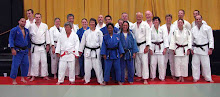
I have a pretty laissez faire perspective on attendance. I refuse to force students to come to class, especially as the rise up to and past the brown belt level. There are reasons for this but mostly it derives from my personal belief that success in any chosen endeavor must come from within.
So, why should a student show up? This isn’t just about judo or martial arts, it relates to most areas of human endeavor.
When a student starts an activity, especially judo, things are difficult. Moving is hard. Falling hurts. Everybody can throw you and you can’t throw anyone. Instructors and teammates should encourage the new student to keep coming because it will get better. As a student progresses things become less difficult for a time and success becomes more frequent. Then comes the brown belt.
The brown belt grades are hard grades to pass through. They are not especially challenging physically, but they become more mental, especially here. A black belt is not just a brown belt with seasoning. A brown belt needs to show mental discipline and good character. While there are many ways to show these qualities, if you desire to show them, you must show up!
Why should a student show up?
The grades lower than brown belt also have trials and tribulations to undergo. Showing up often and participating much helps growth. Learning to deal with that student who is shorter or heavier than you helps you understand judo better. Learning to deal helps you deal.
You need to show up to class because without class you cannot grow in your judo. Reading about judo is good. Watching judo videos is good. But they pale in comparison to getting on the mat and trying these things out!
Practice does not make perfect. Only perfect practice makes perfect. No matter how many shadow uchikomi you do, no matter how many times you practice your foot sweeps against a pole or a wall, no matter how many times you work alone you cannot progress without qualified input. You get qualified input at class!
Show up, have fun, learn. You will get better.
09 August 2010


08 August 2010
Contemplation of the Future
Every judo club needs to look to its future. What happens if the unthinkable happens? What will happen to the club if the sensei leaves? Will the club continue? Who will teach? Who will take care of the paperwork that the sensei does?
Let’s start with what it takes to run a club, specifically Roswell Judo Club. Roswell Judo Club is organized as a sole proprietorship. This is not the best organizational structure, however a 501(c)3 structure costs a fair bit and we are not ready for that. The business aspect, as anathema as that is to many judo instructors, requires tax considerations, such as gross receipts; inventory ordering; scheduling events; and membership filings.
The business considerations require an individual that understands basic bookkeeping, business demands, and judo association guidelines. I certainly won’t say that I’m the world’s best business person at the moment, but I haven’t had anyone volunteer to take over or even learn how the operation works. I probably won’t look into that until 501(c)3 status is attained anyway.
The second aspect of running a club is instructional. Who will teach the classes? Does it require only one instructor or can there be several instructors teaching different classes? Simply put, I think several instructors would be a much greater idea than a single person. Multiple instructors mean that when one must go for the time, the classes aren’t cancelled.
Unfortunately, training instructors is a bit different than teaching judoka. Judoka learn techniques and how to apply those techniques. Teachers need to know the techniques and how to apply them, but that is the least of the concern! Teachers have to know how to transfer that knowledge to their students effectively. A teacher that teaches adults only may or may not be able to teach kids and vice versa. This takes time, both to learn the techniques and learn to teach them.
Right now Roswell Judo Club is not facing this situation, but how far in the future should a club look? In RJC’s case, we have to look about a year and a half to two years in advance. Why do we have to look a year and a half to two years? Currently we don’t have anybody at a level to take over. While we do have two brown belts on the rolls, one is leaving town soon and the other is less available to take over. After these two brown belts our highest grades are orange which will take until at least December of 2011 to move to the low brown belt grade. The most probable case will be May of 2011.
My club members need to understand that I’m not looking at leaving right now. I do want to make it clear that every student should be looking at the future and thinking about what they want to do with their judo. Do you want to be a teacher? Do you want to start your own club? Do you want to just be a club member? All of these are fine and we’ll certainly get you to where you want to be.
Let’s start with what it takes to run a club, specifically Roswell Judo Club. Roswell Judo Club is organized as a sole proprietorship. This is not the best organizational structure, however a 501(c)3 structure costs a fair bit and we are not ready for that. The business aspect, as anathema as that is to many judo instructors, requires tax considerations, such as gross receipts; inventory ordering; scheduling events; and membership filings.
The business considerations require an individual that understands basic bookkeeping, business demands, and judo association guidelines. I certainly won’t say that I’m the world’s best business person at the moment, but I haven’t had anyone volunteer to take over or even learn how the operation works. I probably won’t look into that until 501(c)3 status is attained anyway.
The second aspect of running a club is instructional. Who will teach the classes? Does it require only one instructor or can there be several instructors teaching different classes? Simply put, I think several instructors would be a much greater idea than a single person. Multiple instructors mean that when one must go for the time, the classes aren’t cancelled.
Unfortunately, training instructors is a bit different than teaching judoka. Judoka learn techniques and how to apply those techniques. Teachers need to know the techniques and how to apply them, but that is the least of the concern! Teachers have to know how to transfer that knowledge to their students effectively. A teacher that teaches adults only may or may not be able to teach kids and vice versa. This takes time, both to learn the techniques and learn to teach them.
Right now Roswell Judo Club is not facing this situation, but how far in the future should a club look? In RJC’s case, we have to look about a year and a half to two years in advance. Why do we have to look a year and a half to two years? Currently we don’t have anybody at a level to take over. While we do have two brown belts on the rolls, one is leaving town soon and the other is less available to take over. After these two brown belts our highest grades are orange which will take until at least December of 2011 to move to the low brown belt grade. The most probable case will be May of 2011.
My club members need to understand that I’m not looking at leaving right now. I do want to make it clear that every student should be looking at the future and thinking about what they want to do with their judo. Do you want to be a teacher? Do you want to start your own club? Do you want to just be a club member? All of these are fine and we’ll certainly get you to where you want to be.
30 July 2010
Developing Teachers and Tonight's Class
Judo, unlike many other sports, is an educational process. Like other sports, however, it helps its student develop character, motor skills, discipline, and many of the characteristics our society values. The difference between judo, and other martial arts, and sports like soccer, American football, and baseball is the ability to cause great harm through the normal course of the activity if the participants don’t internalize the values of judo.
One of the biggest problems in martial arts is the development of quality instructors. Certainly there are many instructors in the martial arts but the critical criterion is quality. I’m not interested in pointing a negative spotlight on poor teaching; I don’t care a whit about ferreting out bad instructors. I am interested in the best process I can use to develop my students to teachers.
Nationally, the United States Judo Association seems to be making the greatest strides toward developing a national minimum level of coaching ability. Unfortunately, the process has taken an extremely long time but progress is moving smoothly, apparently. The problem with this is that a coach is not a teacher.
Some say that a teacher is more difficult than a coach. Others say that coaching is harder than teaching. I disagree with both. Teaching and coaching are equally difficult, but differently difficult. Some judo players are adept at teaching, others at coaching. The process of developing the teacher and coach must be a process. USJA is doing well with the coaching process, but not far enough in the teaching process.
Again, I’m not here to bash anyone that’s trying to develop a good method for teaching or coaching. I’m just throwing out some observations.
Okay, so what am I doing since no one else is doing things to my satisfaction? (That sounds arrogant, doesn’t it?)
Right now, I have two students that appear to be interested in teaching. Both of them I have help out in the kids’ class or working with lower kyu grades. My classes are loosely structured with simple building blocks and these students that are interested work with the more senior group of students.
For example, today two brand new students came to class. The remaining four youth students worked under the guidance and supervision of my brown belt. While he was not specifically developing the curriculum to be taught to these students, he was tasked with guiding them through their assigned tasks. The tasks were their ukemi, various drills, and nage waza. He did well.
One of the biggest problems in martial arts is the development of quality instructors. Certainly there are many instructors in the martial arts but the critical criterion is quality. I’m not interested in pointing a negative spotlight on poor teaching; I don’t care a whit about ferreting out bad instructors. I am interested in the best process I can use to develop my students to teachers.
Nationally, the United States Judo Association seems to be making the greatest strides toward developing a national minimum level of coaching ability. Unfortunately, the process has taken an extremely long time but progress is moving smoothly, apparently. The problem with this is that a coach is not a teacher.
Some say that a teacher is more difficult than a coach. Others say that coaching is harder than teaching. I disagree with both. Teaching and coaching are equally difficult, but differently difficult. Some judo players are adept at teaching, others at coaching. The process of developing the teacher and coach must be a process. USJA is doing well with the coaching process, but not far enough in the teaching process.
Again, I’m not here to bash anyone that’s trying to develop a good method for teaching or coaching. I’m just throwing out some observations.
Okay, so what am I doing since no one else is doing things to my satisfaction? (That sounds arrogant, doesn’t it?)
Right now, I have two students that appear to be interested in teaching. Both of them I have help out in the kids’ class or working with lower kyu grades. My classes are loosely structured with simple building blocks and these students that are interested work with the more senior group of students.
For example, today two brand new students came to class. The remaining four youth students worked under the guidance and supervision of my brown belt. While he was not specifically developing the curriculum to be taught to these students, he was tasked with guiding them through their assigned tasks. The tasks were their ukemi, various drills, and nage waza. He did well.
26 July 2010
A Brief Catch-up and Something Interesting
It’s been a fair amount of time since last I wrote. Judo at the club has been moving along, but I’ve been busy job hunting. Roswell is a hard town for jobs of the “over qualified.” I’ve got some plans for the blog for the next month or so and should be writing more often.
I’ve been looking at some interesting stuff lately and working on developing some plans. I love research and have been doing a lot lately. I found an interesting looking book on kanji that I’m going to try to pick up (maybe someone will buy it for me for my birthday, which just passed). I found some interesting questions regarding the highest possible ranks in judo. And I am going to talk about my kids’ classes.
First, the book: it’s called “The Key to Kanji” and it’s written by Noriko Kurosawa Williams. It’s not like most kanji books where they essentially define the character so you have to memorize what it looks like and the stroke order. Instead, it’s a break-down of the kanji and it’s evolution to its current appearance. This strikes me as similar to teaching root words, prefixes, and suffixes for all of our Latin and Greek based words in English. (And chords of “Why Can’t the English Teach Their Children How to Speak” from “My Fair Lady” go passing through my head.)
That weblink gives two sample pages (click on the Preview tab) that you can print out to evaluate. Or, if you just want them handed to you…Kanji_301-600_1R 1.pdf and Kanji_301-600_1R 2.pdf.
I’m going to expound upon this pdf in another post, but to give you something to read now: JudoKodokan-Nov1963-20QuestionsRank.pdf. Some of the interesting bits are Questions 6, 10, 12 (this is for AnnMaria and a comment she made at the JudoForum Camp in 2008), 14, 16, 17, 18, and 20.
I’ve been looking at some interesting stuff lately and working on developing some plans. I love research and have been doing a lot lately. I found an interesting looking book on kanji that I’m going to try to pick up (maybe someone will buy it for me for my birthday, which just passed). I found some interesting questions regarding the highest possible ranks in judo. And I am going to talk about my kids’ classes.
First, the book: it’s called “The Key to Kanji” and it’s written by Noriko Kurosawa Williams. It’s not like most kanji books where they essentially define the character so you have to memorize what it looks like and the stroke order. Instead, it’s a break-down of the kanji and it’s evolution to its current appearance. This strikes me as similar to teaching root words, prefixes, and suffixes for all of our Latin and Greek based words in English. (And chords of “Why Can’t the English Teach Their Children How to Speak” from “My Fair Lady” go passing through my head.)
That weblink gives two sample pages (click on the Preview tab) that you can print out to evaluate. Or, if you just want them handed to you…Kanji_301-600_1R 1.pdf and Kanji_301-600_1R 2.pdf.
I’m going to expound upon this pdf in another post, but to give you something to read now: JudoKodokan-Nov1963-20QuestionsRank.pdf. Some of the interesting bits are Questions 6, 10, 12 (this is for AnnMaria and a comment she made at the JudoForum Camp in 2008), 14, 16, 17, 18, and 20.
25 April 2010
What's Been Going On
Well, it’s been a few days since I last had anything to say. Tonight, however, I have a little bit to say.
These last two weeks I’ve been working on improving some of my sutemi waza. This is always a difficult thing to do when you consider that I’m the highest ranked person participating in my club! So, the solution I’ve come up with is to use YouTube to help me get better.
What I do is video myself and my usual uke. I perform a series of throws, sometimes just one throw over and over again, other times a couple of different throws. Then I ask several rather reliable individuals to evaluate me. I do this through the JudoForum or by instant messaging.
It seems to work out. Now, I don’t always like the responses I get, but that’s what learning and becoming better gets you. If you ask people you trust to give honest feedback, expect honest, perhaps even brutally so, feedback. Once you get that feedback, apply it!
If you’re wondering what they are, I’ve put the YouTube videos below. (Oldest to newest, starting 12 April 2010 and running until 22 April 2010.)
Now, the other thing I’ve been working on is developing a kind of guide like the Gracies use in their Gracie Combatives program. This includes the lesson plans and the note taking section. I think that is one of the best developments they’ve done for martial arts. Say what you will about their marketing and legal strategies, they’ve got a great product for a great price!
It’s a difficult thing to create and I’m having a hard time with it, but it’ll work out in the end. Oh, and great thanks to Kristan for hopping on the bandwagon to help create the artwork for one of my other projects. She rocks!
These last two weeks I’ve been working on improving some of my sutemi waza. This is always a difficult thing to do when you consider that I’m the highest ranked person participating in my club! So, the solution I’ve come up with is to use YouTube to help me get better.
What I do is video myself and my usual uke. I perform a series of throws, sometimes just one throw over and over again, other times a couple of different throws. Then I ask several rather reliable individuals to evaluate me. I do this through the JudoForum or by instant messaging.
It seems to work out. Now, I don’t always like the responses I get, but that’s what learning and becoming better gets you. If you ask people you trust to give honest feedback, expect honest, perhaps even brutally so, feedback. Once you get that feedback, apply it!
If you’re wondering what they are, I’ve put the YouTube videos below. (Oldest to newest, starting 12 April 2010 and running until 22 April 2010.)
Now, the other thing I’ve been working on is developing a kind of guide like the Gracies use in their Gracie Combatives program. This includes the lesson plans and the note taking section. I think that is one of the best developments they’ve done for martial arts. Say what you will about their marketing and legal strategies, they’ve got a great product for a great price!
It’s a difficult thing to create and I’m having a hard time with it, but it’ll work out in the end. Oh, and great thanks to Kristan for hopping on the bandwagon to help create the artwork for one of my other projects. She rocks!
20 April 2010
Roswell Judo Club Students
I don’t often write about my club. Usually I just write about things that have interested me or that I’m studying for judo or the Gracie program. Today, though, I’m going to write about my club.
Tonight’s practice had five of my club members practicing. I shot video, like I tend to do. But I watched it, which I’m not really in the habit of doing, and certainly not immediately. As I watched it dawned on me that I am really blessed to have such amazing students.
Five students isn’t a lot of students, but when Rolando and I were working on the Nage no Kata, which is atrocious, they all sat and watched intently. How often do you find four novices, I mean absolute beginners, willing to really sit and watch what one elite athlete said was, “boring as watching flies f***.” (Direct quote, and no, I won’t say who! But it was hilarious to hear that…)
After the brief attempt at kata, which while atrocious isn’t bad when one considers I haven’t practiced the full set since gaining Shodan in 2005 and having a partner who’s never done the full set, they all got back to work with zero grumbling and worked hard! We didn’t concentrate on anything competitive, just basic nage waza. They’re not perfect, but they keep working at them trying to make them better.
I just want to say this to the world and, most especially, my students: I have got some of the best students any instructor could ever ask for. These are the people for whom I do judo.
Tonight’s practice had five of my club members practicing. I shot video, like I tend to do. But I watched it, which I’m not really in the habit of doing, and certainly not immediately. As I watched it dawned on me that I am really blessed to have such amazing students.
Five students isn’t a lot of students, but when Rolando and I were working on the Nage no Kata, which is atrocious, they all sat and watched intently. How often do you find four novices, I mean absolute beginners, willing to really sit and watch what one elite athlete said was, “boring as watching flies f***.” (Direct quote, and no, I won’t say who! But it was hilarious to hear that…)
After the brief attempt at kata, which while atrocious isn’t bad when one considers I haven’t practiced the full set since gaining Shodan in 2005 and having a partner who’s never done the full set, they all got back to work with zero grumbling and worked hard! We didn’t concentrate on anything competitive, just basic nage waza. They’re not perfect, but they keep working at them trying to make them better.
I just want to say this to the world and, most especially, my students: I have got some of the best students any instructor could ever ask for. These are the people for whom I do judo.
12 April 2010
Tournament Success
Roswell, New Mexico is right out in the middle of nowhere. We are three hours from the three major towns in New Mexico (Albuquerque, Santa Fe, and Las Cruces). New Mexico, if we’re lucky, holds two tournaments a year, both in Albuquerque. El Paso, maybe, holds one tournament a year. All these factors and a few others make it easy to see why the Roswell Judo Club doesn’t go to tournament.
All that being said, however, we finally took one to tournament. We took Alana Brumbaugh to the Southwest Championships held by Synergy Martial Arts at the Rio Rancho High School on the 27th of March. It was a wonderful experience for both her and me (as the coach).
For those of you who are unaware of judo tournaments and matches, a brief explanation is in order. First, tournaments are divided into divisions like Juniors, Seniors, and Masters. These divisions are age brackets. Further dividing these divisions are sex, weights, and ranks, if there are enough competitors to justify dividing them. Typically Senior Women’s divisions, especially in New Mexico, are not divided at all.
The matches are timed with a maximum length of time for competing but can be shortened for a number of reasons, including an Ippon throw, submission (tap out), unconsciousness (through a choking technique), penalties, or medical reasons. Senior Women’s matches are set for three minutes duration.
Alana had three matches. Her potential time on the mat for competition was nine minutes, but she didn’t need all of them! Watch the matches in the video below!
She did a great job with her matches and I was spectacularly proud of her effort and work.
I would like to thank Synergy Martial Arts for holding this tournament. I wish the scheduled Referee clinic had been held, but limited interest is limited interest I suppose.
All that being said, however, we finally took one to tournament. We took Alana Brumbaugh to the Southwest Championships held by Synergy Martial Arts at the Rio Rancho High School on the 27th of March. It was a wonderful experience for both her and me (as the coach).
For those of you who are unaware of judo tournaments and matches, a brief explanation is in order. First, tournaments are divided into divisions like Juniors, Seniors, and Masters. These divisions are age brackets. Further dividing these divisions are sex, weights, and ranks, if there are enough competitors to justify dividing them. Typically Senior Women’s divisions, especially in New Mexico, are not divided at all.
The matches are timed with a maximum length of time for competing but can be shortened for a number of reasons, including an Ippon throw, submission (tap out), unconsciousness (through a choking technique), penalties, or medical reasons. Senior Women’s matches are set for three minutes duration.
Alana had three matches. Her potential time on the mat for competition was nine minutes, but she didn’t need all of them! Watch the matches in the video below!
She did a great job with her matches and I was spectacularly proud of her effort and work.
I would like to thank Synergy Martial Arts for holding this tournament. I wish the scheduled Referee clinic had been held, but limited interest is limited interest I suppose.
Subscribe to:
Posts (Atom)

 Posts
Posts